The customer service landscape has permanently changed. Businesses that once employed dozens of agents to handle routine inquiries can now automate 60-70% of that volume with AI. But businesses that tried to replace human agents entirely with chatbots discovered something important: certain interactions require a human touch that no current AI can replicate.
The real question in 2026 isn't 'AI or humans' — it's 'what proportion of each, for which interactions, at what points in the customer journey?' This guide gives you the framework to answer that question for your specific business.
The Honest Case for AI Customer Service
What AI Does Better Than Humans
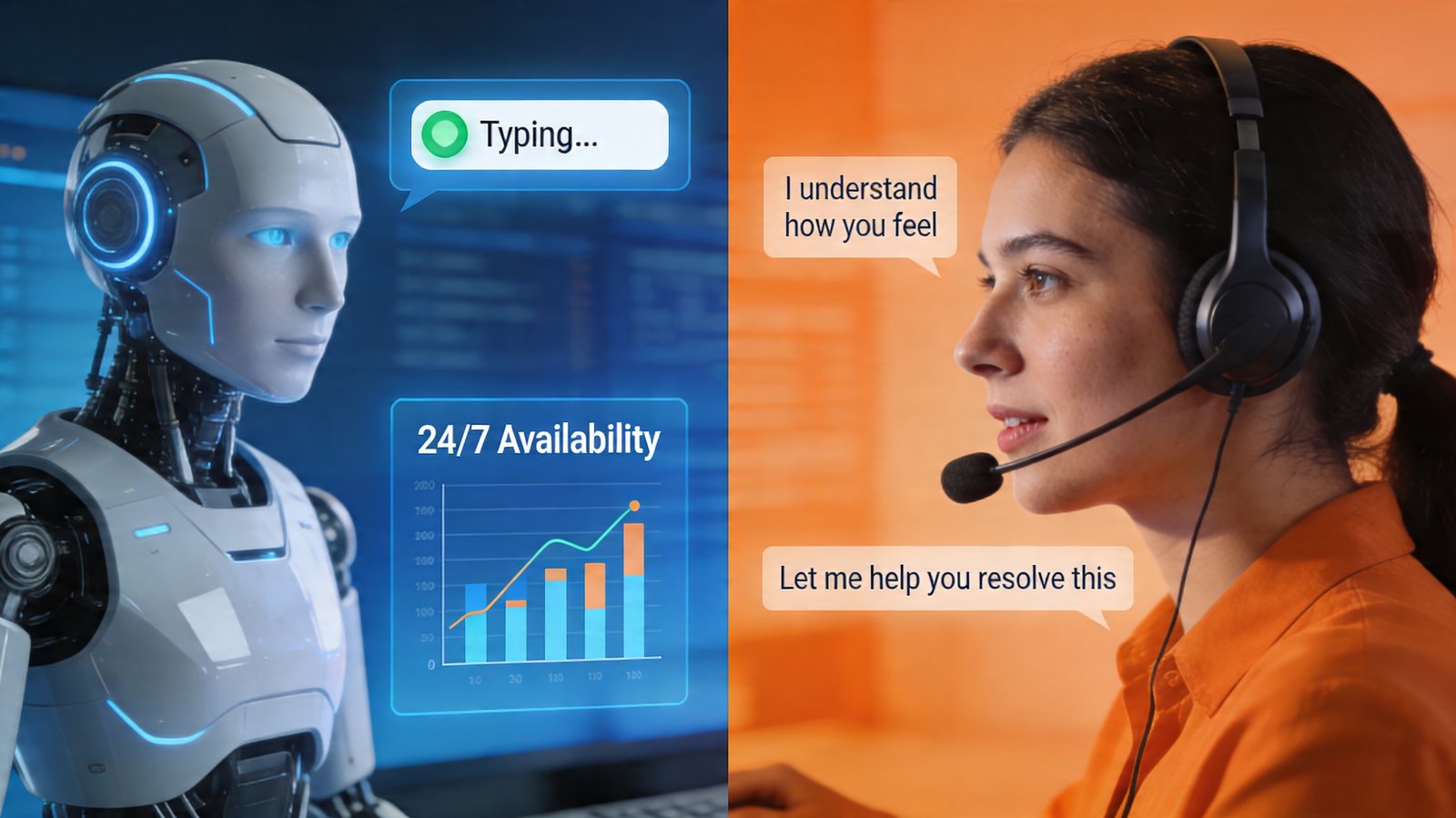
For routine, information-based interactions, AI genuinely outperforms humans on several metrics. Speed: AI responds in milliseconds, humans typically in minutes. Availability: AI operates 24/7/365 without sick days, holidays, or staffing challenges. Consistency: AI gives the same answer to the same question every time; human agents vary. Scalability: AI handles 1 or 10,000 simultaneous conversations at equal cost. Cost at scale: A well-deployed AI chatbot handles hundreds of thousands of interactions per month for a fraction of the cost of equivalent human staffing.
The Gartner Research Reality
Gartner research consistently shows that by 2026, 80% of customer service and support organizations are using AI in some form. Among companies that have deployed AI customer service, average handle time for routed interactions has decreased 40%, first-contact resolution rates have improved 25%, and customer service costs have decreased by 30-40% for the interactions AI handles. These are real, significant numbers.
The Honest Case for Human Customer Service
Where Humans Are Irreplaceable
Emotional intelligence in escalated situations is the most obvious area. When a customer is genuinely distressed — after a significant loss, a serious service failure, or a health or safety issue — the human capacity to express genuine empathy and take personal ownership of a solution creates outcomes that no AI currently achieves. Customer retention after a service failure handled well by an empathetic human agent is measurably higher than after the same failure handled by AI.
Complex, non-standard situations are another human stronghold. When a customer's situation doesn't fit any of the patterns the AI has learned, humans can exercise judgment, improvise, and find solutions outside the script. High-value relationship management, consultative selling for complex products, and situations with significant ethical or legal complexity all require human judgment.
Customer Satisfaction Data: What the Research Shows
PwC research found that 75% of consumers want human interaction available in customer service, even if they don't always need it. Simultaneously, 59% of the same consumers say they prefer digital self-service for routine tasks. The conclusion isn't contradictory: customers want AI for convenience on simple tasks and humans available when things get complicated or emotional.
Microsoft's 2023 global customer service report found that CSAT (Customer Satisfaction Scores) for AI-handled interactions that stayed with AI averaged 3.8/5. For interactions that were escalated from AI to a human, average CSAT jumped to 4.4/5. The escalation path itself, handled well, drives satisfaction higher than either channel alone.
Building the Optimal Hybrid Model
The Tiered Interaction Framework
Tier 1 (AI handles fully): Password resets, order status, shipping estimates, FAQs, appointment scheduling, basic troubleshooting with defined resolution paths. These interactions follow predictable patterns, have clear correct answers, and don't carry emotional weight. AI handles these better and cheaper than humans for most businesses.
Tier 2 (AI assists, human decides): Product recommendations for complex purchases, complaint investigations, refund decisions above thresholds, and situations requiring judgment about policy exceptions. AI collects and presents relevant information; the human makes the final call.
Tier 3 (Human handles only): Escalated complaints, legal or compliance situations, high-value account management, crisis situations, and any interaction involving genuine distress. These should route directly to a skilled human agent with full context.
Implementation Mistakes to Avoid
The most damaging mistake is designing AI customer service without a clear escalation path. Customers who are trapped in AI loops they can't escape from — unable to reach a human — have the most negative service experiences of all. Build the escalation path first, before anything else. Second mistake: not training the AI on your specific products, policies, and customer language. Generic chatbots produce generic (wrong) answers; AI trained on your knowledge base produces accurate, brand-consistent responses.
Cost-Benefit Analysis Framework
To determine your optimal AI-human ratio, calculate: your current cost per interaction by channel, your interaction volume by type (tier 1/2/3 using the framework above), AI platform cost at your interaction volume, and quality impact cost (customer churn from poor AI interactions). Most businesses find that implementing AI for tier 1 interactions while preserving human service for tier 2 and 3 produces the best combined outcome of cost reduction and CSAT maintenance.
Conclusion
Neither pure AI nor pure human customer service is optimal for most businesses. The winning approach in 2026 is a thoughtfully designed hybrid that routes interactions by complexity and emotional weight. Deploy AI where it's genuinely better — routine, information-based, 24/7 availability. Deploy humans where they're genuinely better — complexity, emotion, high-stakes relationships. The hybrid model reduces costs while improving the customer experiences that drive loyalty.