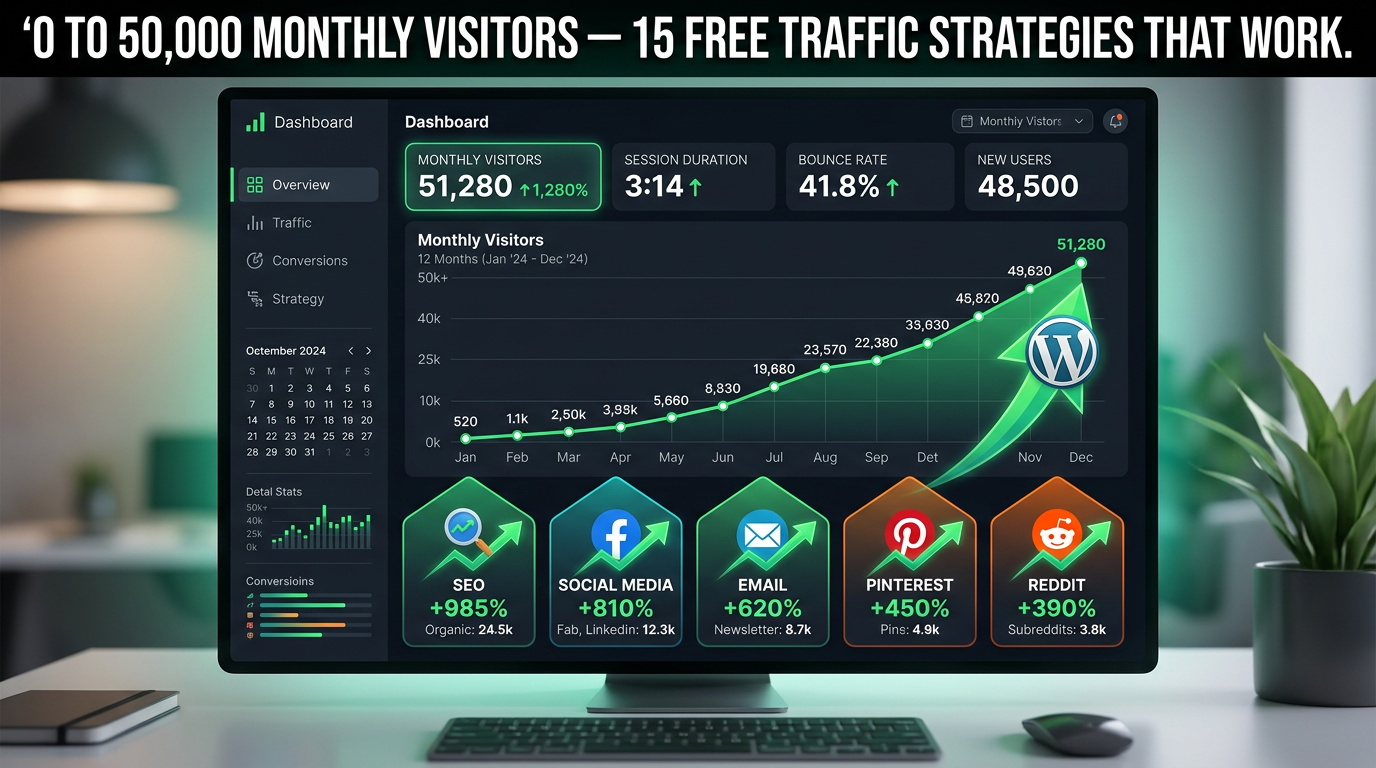
Every website owner wants more traffic. But the most common response — running paid ads — ignores the fact that some of the highest-quality, most sustainable traffic sources are completely free. The 15 strategies below have generated meaningful traffic for real websites, require no advertising budget, and many can start delivering visitors within days.
Strategy 1: Target Long-Tail Keywords in Blog Content
Short, broad keywords like 'marketing tips' are dominated by major publications with millions of backlinks. Long-tail keywords like 'email marketing tips for yoga studios' have genuine search volume and far less competition. A new website can realistically rank for carefully chosen long-tail keywords within weeks.
Action: Research 10-15 long-tail keywords in your niche using Ubersuggest (free) or Google's Autocomplete. Create one dedicated blog post per keyword. Publish consistently.
Strategy 2: Optimize Existing Content for Better Rankings
You likely have existing content that ranks on page 2 or 3 — receiving almost no traffic despite being close. Improving these near-miss pages is the highest-ROI SEO activity available.
Action: In Google Search Console, go to Performance > filter by Position between 5 and 20. These are your near-miss pages. Update the content, add more depth, improve the title and meta description, and add internal links pointing to them from other pages.
Strategy 3: Publish Consistently on Pinterest
Pinterest is a visual search engine, not just a social network. Pins have a much longer lifespan than social posts — a pin can drive traffic for months or years after being published. For niches involving food, home decor, finance, marketing, wellness, and education, Pinterest drives significant referral traffic.
Action: Create vertical (2:3 ratio) image pins for every blog post. Include the article title on the image. Publish 5-10 pins per day using Tailwind (free trial) to schedule them.
Strategy 4: Be Genuinely Helpful on Reddit and Quora
Reddit and Quora are question-and-answer platforms with enormous traffic. When you provide genuinely useful, detailed answers to questions related to your content — and include a contextually relevant link to your website — you can receive targeted referral traffic.
The critical rule: be helpful first, promotional never. Communities ban users who spam links. Write the answer so thoroughly that the link is a 'further reading' supplement, not the main purpose.
Strategy 5: Internal Linking Strategy
Internal links (links between pages on your own website) distribute 'link equity' and guide visitors to more of your content. Websites with strong internal linking structures see lower bounce rates and more pages viewed per session.
Action: Whenever you publish a new article, link to it from 3-5 relevant existing articles. Monthly, audit your most popular pages and add internal links to recent content.
Strategy 6: Build an Email List and Send Weekly Updates
Your email list is a direct traffic channel. Every newsletter you send drives a spike in website visits from engaged, returning readers. Returning visitors have significantly lower bounce rates and higher conversion rates than first-time visitors.
Action: Add an opt-in form to your website, create a lead magnet, and send a weekly email featuring your latest content with a compelling subject line.
Strategy 7: Republish Content on Medium and LinkedIn
Syndicating content means republishing your existing articles on platforms with their own audiences — without duplicate content penalty if done correctly. Medium and LinkedIn Articles have built-in readership that can discover your content.
Action: Wait two weeks after publishing original content (to allow Google to index your version first). Then republish on Medium with a canonical link pointing to your original. Import the full article to LinkedIn Articles for professional-topic content.
Strategy 8: Create a Free Tool or Resource
Free tools attract backlinks, bookmarks, and word-of-mouth sharing more effectively than any other content type. A mortgage calculator, word count tool, template download, or ROI calculator on your website earns links automatically because people reference it in their content.
Examples: a marketing budget calculator, a social media post length checker, a grammar checker, a color palette generator. These tools attract links from other blogs in your industry, building domain authority.
Strategy 9: Guest Posting for Referral Traffic and Backlinks
Writing guest articles for established websites in your niche sends their readers to your website via the author bio link and earns a valuable backlink. The referral traffic from a single guest post on a high-traffic site can exceed a month of organic growth.
Action: Identify 10 websites in your niche that publish guest posts (search 'write for us' + your topic). Pitch genuinely original, valuable articles that serve their audience — not thinly veiled self-promotion.
Strategy 10: Answer Questions in Facebook Groups
Facebook Groups exist for virtually every industry and interest. When you consistently provide genuine, expert answers to questions in relevant groups — with occasional contextual links to relevant resources — group members visit your profile and website.
The key: add massive value first. Become a known, trusted voice in the community before mentioning your website.
Strategy 11: YouTube Videos With Website Links
YouTube is the second largest search engine in the world. Creating videos around keywords you are targeting for blog content creates a second channel to the same traffic. Link to your website in the video description and within the video verbally and visually.
Even one video per week, consistently published over a year, builds a substantial traffic source.
Strategy 12: Publish Original Research or Data
Original research, surveys, and data studies attract backlinks from other content creators who want to cite statistics. A study like '2026 survey: how 500 small business owners approach email marketing' will be linked by bloggers and journalists writing about email marketing.
Survey tools: Google Forms, Typeform. Share results with industry publications and journalists in your space using HARO (Help A Reporter Out).
Strategy 13: Build Topical Authority With Content Clusters
Google increasingly rewards websites that demonstrate comprehensive expertise in a specific topic area. Content clusters — a central 'pillar' page on a broad topic linked to multiple 'cluster' pages on specific subtopics — signal topical authority.
Example pillar: 'The Complete Guide to Email Marketing.' Cluster pages: 'email marketing for restaurants,' 'welcome sequence examples,' 'email marketing metrics explained.' All cluster pages link back to the pillar.
Strategy 14: Update Old Blog Posts
Google's freshness signal means recently updated content ranks better for time-sensitive queries. Revisiting posts from 1-2 years ago, updating statistics, adding new information, and improving readability can boost rankings within weeks.
Action: Audit posts that have dropped in rankings. Update all outdated information, add 300-500 words of new insights, update the publish date, and add new internal links.
Strategy 15: Build Relationships With Other Content Creators
The fastest path to traffic growth is often collaboration. When another website in your niche shares your content, you instantly access their entire audience. Build genuine relationships by featuring others, commenting meaningfully on their content, and collaborating on joint projects — before asking for anything.
Conclusion
Free website traffic is not instant, but every strategy on this list compounds over time. Long-tail SEO traffic grows month after month. Email list traffic regenerates with every newsletter. Pinterest pins work for years. Choose three strategies from this list that align with your strengths and resources, execute them consistently for 90 days, and measure the results. Traffic growth is a system, not a one-time event.